

Give Them the Slice, Not the Cake: How to Build a Church Next Steps Pathway
Your Get Connected page has forty-plus opportunities on it.
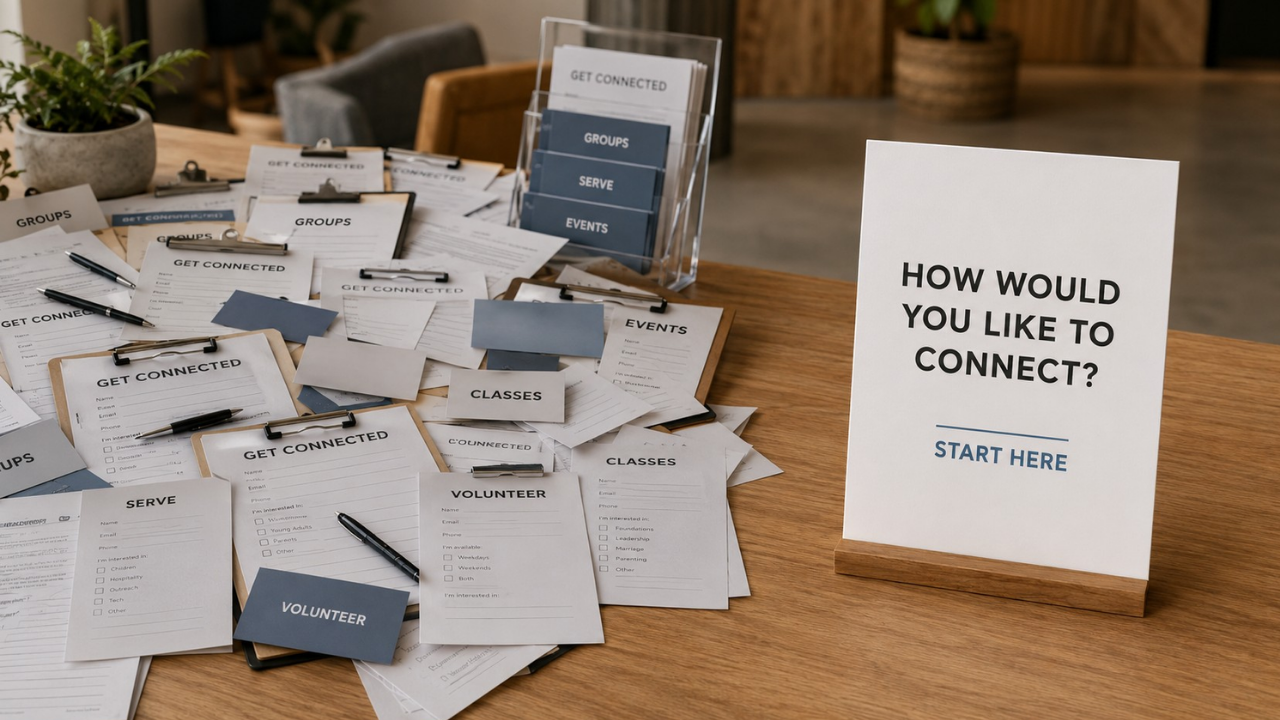
There's a brochure. There's a table in the lobby every weekend of your fall connection push.
Sign-ups look busy. Follow-through doesn't.
You've started to suspect the list itself is the problem.
But you've also been trained to believe that more options is how you show people you have something for everyone.
Here's the harder truth: the list isn't too long because your church has too much going on.
It's too long because it asks the reader to do something they were never equipped to do standing in a lobby - diagnose their own need,
compare it against forty choices, and pick the right door on their own.
That's not a commitment problem. That's a design problem.
The list isn't too long.
It's asking the wrong question.
A 40-item Get Connected list assumes every guest already knows what they need.
Most don't. What they actually have is one honest question: where am I right now, and what's the one thing I do next?
A list can't answer that question. It just hands the reader forty possible answers and asks them to sort it out alone. So they do what anyone does when a decision feels too big to make on the spot — they take the brochure home and set it on the counter. That's not disinterest. That's decision fatigue, and it's the actual reason your sign-ups look busy while your follow-through doesn't.
What does a next steps pathway do differently
A next steps pathway replaces the list with a sequence.
Instead of forty parallel options, it sorts people into a handful of honest starting points - new here, connected but not yet serving, ready to grow and gives each one exactly one next action, not a menu.
This isn't a new idea in church strategy circles. The Unstuck Group has made the same case in their guest engagement research:
Clarity beats volume when it comes to what you ask a guest to do next (Next Steps Guest Engagement, The Unstuck Church Podcast).
The difference between a list and a pathway isn't how much your church offers.
It's whether the reader has to figure out where they fit before they can act.
Picture your lobby table cut down from forty sign-up sheets to one card that asks a single question, "Is this your first time, or have you been here a while?" and hands back one next step based on the answer. Same ministries. Same opportunities. One decision instead of forty.
What changes when the pathway replaces the list
Your team stops managing forty competing sign-up sheets. One pathway, one set of next steps to track and follow up on.
Guests stop bouncing off decision fatigue. One clear ask is something a person can say yes to in the lobby, not something they take home and forget.
Follow-through improves because the next step is specific. "Come to the Sunday morning connection class at 9:15" gets acted on. "Choose from forty ministries" doesn't.
Your fall push measures something real. Instead of counting how many brochures went home, you're counting how many people took their one next step.
Where to start before your fall push
You don't need to rebuild every ministry page to fix this. Start narrower:
Audit what you're actually asking. Pull your current Get Connected list and count the choices a first-time guest sees before they can act. If it's more than three, that's the problem.
Define three or four honest starting points. New here. Connected but not plugged in. Ready to serve. Ready to grow. Most people fit one.
Give each starting point exactly one next step, not a category of options.
Redesign the table and the page around the pathway, not the list, before your fall connection push goes live.
None of this requires more programs. It requires deciding, on your team's behalf, what the next right step actually is, so your guests don't have to guess.
Clarify Your Next Steps: Schedule a free call with Story & Stone.
We'll look at your current Get Connected list together and map the pathway your church actually needs.